
How Hands-On Learning Changed My Teaching and My Career
- Emily Hajko

- May 1
- 4 min read
Hi, I’m Emily, Director of Education at True Robotics. If you’ve landed here because you are one of our wonderful partners, we briefly met at a conference or event, or you’re just trying to learn more about what’s in the world of educational robotics, I welcome you.
My journey with True Robotics started out as a pretty standard story in the world of education—a summer side-gig to help me make a few extra bucks for my upcoming wedding. This small start-up company needed help writing lesson plans to tie their robotics programming to middle school math and science. At the time, I was teaching


6th-grade science (and trying to plan a wedding), so it was a no-brainer. I ended up continuing to help with the curriculum development part-time for a full year. During that year, I was beginning to see the impact a well-rounded STEM program can have on students and felt pulled to continue to build something that would help students across the country. So, the following summer, I made the monumental decision to step away from my classroom and immerse myself in the work full-time.
Since then, both the company and I have grown together. I now find myself in the position of Director of Education, overseeing overall school success. In this position, my days are filled with school outreach, running teacher PD sessions, engaging students with demos, and I can honestly say my teacher heart has never been more full.
I was a very classic case of “I’ve only ever wanted to be a teacher.” Complete with forcing my little brother to play ‘school’ with me for hours and do fake worksheets so I could practice correcting papers…Yes, I envisioned grading

to be a much more exciting process than it actually turned out to be. I stuck with that plan from six years old up through college, earning my B.A. in Elementary Education from Endicott College in Beverly, Massachusetts. Immediately after graduation, I began my work in the Quaboag Regional School District, a small district here in Massachusetts, while working towards my M.Ed. in Elementary Mathematics Education from Lesley University in Cambridge, Massachusetts. While working at Quaboag, I was sent to a training to be a lead teacher for a new initiative the district was putting in: Project Lead the Way. This was my first taste of real, authentic, hands-on STEM.
The Moment Everything Clicked: Discovering the Power of Hands-On STEM Learning
While my time in this position was brief, I instantly saw the impact this type of instruction can have on students. With my fifth graders, we completed a biology module, exploring the spread of disease. Many of you reading this are probably familiar with the type of experiment where we put glow powder on one person’s hand, then played a game of seven up to ultimately track the “germs” back to patient zero. The engagement, the learning, and the retention that took place throughout this unit was more than I ever could’ve expected.

The following year I was offered my dream job of a classroom teaching position in first grade in the Auburn Public Schools in Auburn, Massachusetts. Though a drastically different setting and different role, the impact of kinesthetic and tactile learning shone through. I remember one student in particular- we’ll call him Eric- had an extremely challenging time following through with classroom expectations and completing his schoolwork. As a complete newbie teacher, I really struggled with ways to support him, but I saw the desire and eagerness to learn was there. In conversations with my colleagues, I would express that this poor little boy just couldn’t sit in his desk and finally someone questioned me with: “Then why make him?” The next day I ripped his math worksheet out of the workbook and taped to the classroom wall. I invited him to stand on the side of the room and follow along with the lesson there, where he could pace and move while also actively listening to the instruction. His performance was night and day. I couldn’t believe it.
After a few years teaching first grade, I was ready for a new challenge. I transferred internally to a sixth-grade science position in the same district. In this setting, I worked with a team of teachers who taught the other core subjects. It became very evident to me that many students who struggled in their other courses were seeing success in my science classroom. I truly credit the hands-on nature of science as to why these kids were succeeding. This is when I really started to reflect on the nature of all our classrooms and all our schools across the country and think about the way we are approaching teaching and learning. I think we can all agree that the shift to authentic hands-on learning is essential for today’s students.

Bringing Robotics Education to Life
in Classrooms Across the Country
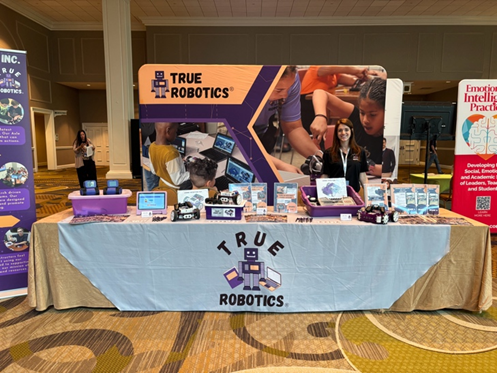
This is why my work at True Robotics has been so fulfilling. Through our robotics programs, we’ve been able to bring to life the learning that is taking place in so many classrooms. We put cross-curricular focuses at the heart of every curriculum we create so that robotics becomes a tool for every student to see success in every class. It excites me when I have an opportunity to listen to teachers and administrators express the challenges that they’re having within their walls and know that I can offer them real support and tools that are going to make a difference in their students’ lives. It’s time we stop trying to fix kids to fit the system and instead let’s fix the system to fit our kids.
If you’re still here, I thank you for learning about my story. I would love nothing more than to learn all about yours. Please consider reaching out to me at Emily@truerobotics.org so we can continue these important conversations. Please also consider following True Robotics on all social media platforms to continue following along with us in this important work.

